

Curbing the Rising Prices of Medicines- Reviewing the Policy Framework
The Parliamentary Standing Committee on Chemical and Fertilisers presented its report on ‘Price Rise of Medicines in the Pharmaceutical Sector Impacting the Lives of Ordinary Citizens Adversely – A Review’ on December 1, 2025. This report highlighted the persistent high and rising prices of medicines and dwelt at length on the many policy gaps that need to be addressed to limit this rise. There is also considerable published literature that highlight the high costs of medicines as the major contributor to financial hardship and impoverishment consequent on utilisation of medical care. In this conversation between Dr T. Sundararaman (TS), and a leading pharmaco-economist who has worked on this issue for many years, (referred to as Dr S. Guna (SG) for this interview) we try and understand why and how public policy has tried to curb this price rise and what they need to do better.
TS: Let us start with a basic question. Why do we at all need price controls for medicines? Is this an unusual request or limited to developing countries? Do high-income countries have the similar mechanism?
SG: The developing country context is one reason for price control. India is a low- and middle-income country with a relatively low per-capita income. About 90 percent of the population earn less than Rs 10,000 per month. Of this almost 60% goes to food consumption and only 40% is non-food consumption, much of which is essential. So, if the household expenditure on medicines compromises other essential expenditures, we call this a catastrophic health expenditure. The costs of healthcare are one of the main causes of impoverishment and within this the expenditure on medicines is the largest contributor. This is the main reason why we need price controls.
But do note that most high-income countries also have price control for medicines and measures to ensure affordable supply. The only exception is the USA. The mechanism for price control differs from country to country. In most developed countries it is medicines under patents which are under price control. Because of robust universal health systems over 90 percent of generics are prescribed and dispensed without any significant out-of-pocket expenditure as part of the assured public or publicly administered health services. Procurement is in bulk, competitive and from international markets and therefore the costs of generics are manageable for health services in these countries of the Global North. But even for high-income countries patented medicines are either not in supply by the system or can cost too much for public systems to procure- and therefore are brought under price controls. Among several measures, three mechanisms used by high-income countries stand out: the therapeutic reference price, the international reference price and health technology assessment using cost-effective analysis as a basis.
In contrast, in a low-and-middle income country like India, the role of the public health sector in providing access to free medicines is very limited- to only about 30 percent of all medicines utilised. And except in the two states of Tamil Nadu and Rajasthan, the public procurement system is quite inefficient in ensuring uninterrupted supply of medicines to the facilities. Shortages and stockouts are the norm in most states in India and very often, even when a patient receives consultation and prescription in a public hospital or health centre, drugs have to be purchased from a private retail pharmacy.
The other reason is also that the share of funds allocated for procurement and distribution of medicines by the public services is inadequate. Total public health spending on medicines, even in Tamil Nadu and Rajasthan never exceeded 10% of the health budget. More recently they are spending only about 5-6% of their total public health spending on medicines, which is about Rs 1000 crore. In most other states the share is even smaller. It can be as low as 2 or 3% of the total public spending. Which means far greater purchase of medicines by individual patients from the local pharmacies. As you know, in India, almost 60% of total health expenditure comes from households out of pocket expenditure, of which 50 to 60 percentage goes for buying medicines. So those are essentially the reasons why price controls on medicines are a must.
TS: Admitting that much of healthcare utilization happens in the private markets, still, the question remains as to why we need price control? We would expect that when we have more than 10,000 pharmaceutical manufacturers and an open market, the robust competition between manufacturers should have been able to lower the prices? And, whereas in high-income countries, the drug regulation is for patented drugs, here only generics and not patented medicines come under price control.
SG: Let me take these questions one at a time. And begin with an introduction:
The pharmaceutical market, in the Indian context, is organised in 3 different segments- patented medicines, branded generics, and generics. In high-income countries there are only two categories- patented or generics. Patented medicines are those medicines whose manufacture is restricted to those who own the patent- the exclusive right to manufacture that medicine- and this is usually for a period of 20 years. New medicines coming into the market are usually patented medicine. After 20 years, the patent protection goes off and any manufacturer can produce these. World-wide almost 90% of public health needs can be taken care by the generics. Only 8 to 10 percent of needs are met by patented medicines.
In the Indian situation, within generics there is category of pure generics or generic generics and a second category called branded generics. The generic-generics go by an internationally standardised chemical name, known as the International Nonproprietary Name (INN) – eg. paracetamol, or amoxycillin. Public sector procurement for example happens based only on such names. But branded generics are sold on the basis of a brand name. For example, over 110 brands exists involving 650 mg Paracetamol, about 94 brands in the category of 500 mg, and about 56 brands in the category of Paracetamol Suspension 250 mg. This doesn’t include many other brands running into hundreds that involve a combination of Paracetamol with other chemical entities. Some companies may even market the paracetamol they manufacture under two or three brand names. Over 80 percent of the market is of this category of branded generics and only about 10 percent go to non-branded generics.
We exercise no price control at all over patented medicines. It is a monopoly market. But even on generics, despite the argument of the pharma companies, the evidence is that there is very limited competition over brands but none at all over prices. So, we have brand competition, and not price competition. Companies fix prices of their products based on their influence in the market. For example, the bigger Indian pharma brands like Dr. Reddy’s Laboratory, or Sunpharma always fix their prices at a higher level, compared to a relatively new or less well-known company. Companies have their huge influence through marketing strategies, with detail men, or medical representatives as they are called, promoting the drug to the individual prescribers. And prescribers are not price sensitive. With most commodities, the consumer is price-sensitive because they choose and they make the payment. But when it comes to medicines, consumers make the payment, but the choice is made by prescribers, who do not pay. More often than not prescribers have little recall of the prices – they are going only by brand-image. Therefore, pharmaceutical companies have a huge influence over the prescribers. And price competition doesn’t really matter.
But even brand competition is limited. We measure pharmaceutical market concentration and competition through the Herfindahl-Hirschman Index (HHI). If we take the HHI for each chemical entity, the level of oligopoly is quite extensive across different medicines. So, though there are 10,000 manufacturers producing close to about 60,000 branded generics, there are only about 2,400 relevant chemical molecules. If I apply the HHI index for each of those 2400 chemicals, 77% of the molecules have high or medium concentration- in other words an oligopoly- with usually four to 10 players, dominating the market. To give an example, let us say metformin has 50 manufacturers, but of these 4 will have a market share of 80 percent, and the other 20 percent is shared by 46 manufacturers, many with less than one percent market share.
So, if I have to look at competition, I have to look at whether competition exists for each one of these 2400 molecules. And now if we go further and break up by dosage- say 250 mg, 500 mg etc or syrups, tablets, injection etc, the level of concentration becomes even higher. Now an oligopoly may exhibit relatively more competition than the monopoly that exists on a patented medicine, but that’s still not enough to prevent a price which is many times more than the costs of production- and we are therefore by policy allowing super-profits.
TS. Having established the need for price control, could you take us through the history of price control in India?
SG: Though even in the 1950s there was price control, the first major effort was in 1964, during the India-China war as part of an overall control in prices, followed by a first Drug Price Control Order in 1970. Then came the Hathi Committee Report of 1975, a truly far-sighted report that saw the need for self-sufficiency in production as well as the need for medicines price control. Based on its recommendations the first drug policy was formulated in 1978 and the second Drug Price Control Order of 1979 was adopted. Under this order over 90% of drugs (347 drugs) in the market was brought under price control. The mechanism of deciding prices was the costs-plus-based pricing method. This meant that the costs of production were first computed and then an overhead added to account for distribution and profits and the final price was arrived at (called MAPE – Maximum Allowable Post-Manufacturing Expenses).
In those days price control of medicines was part of the Ministry of Chemicals and Fertilizers functions. Now, of course, we have the Department of Pharmaceuticals. Officials from the Ministry of Chemicals and Fertilisers would go to and collect the production costs from the companies. If the net cost including packaging was say Rs 50, then for some drugs the mark-up would be 40%, for others 60% and for others 100%. But that was the limit. Based on life-saving, essential medicines categories, drugs were classified into four categories in 1979, whereby Category 1 considered to be life-saving, would attract a lower MAPE of just 40% as against a MAPE of 60% for non-essential medicines.
That was in 1970s. In 1987 (DPCO 1987), in the first wave of liberalisation many medicines dropped out of price control. Then by 1995 (DPCO 1995), when liberalisation and globalisation were in full swing, only 10 % of drugs on the market were under price control. Moreover, by 1995, the number of categories of drugs were reduced to just one category which attracted 100% MAPE.
In 2002, the ministry came up with a policy to almost completely drop any price control. This was challenged by civil society. An organisation called AIDAN led the challenge, first in Karnataka High Court and then in Supreme Court. The case dragged on until 2008, when Supreme Court started hearing the case. In 2011, the Supreme Court came up with an interim ruling after hearing not only civil society, but also the government and the representatives of the industry. There are three prominent industry-representing organisations. Of these the OPPI or Organisation of Pharmaceutical Producers of India, represents the transnational corporations who dominate the patented medicines market. The second is the IPA or Indian Pharmaceutical Association which largely represents the large Indian Manufacturers like Sunpharma and Ranbaxy, and then comes the IDMA- or Indian Drug Manufacturers Association who represent the MSMEs- the Medium and Small-Scale Industries. All three of these players, who could pay for the highest legal expenses, and the government argued against price control.
Having looked at both the arguments, the Supreme Court directed the government to bring all life-saving and essential medicines under standardized price control. And then for the rest, let the market to decide.
Left with no other option but to abide by what the court said, the Department of Pharmaceuticals had to come up with the pharmaceutical pricing policy of 2012, and this was enacted as the Drug Price Control Order of 2013. Its an order, not an Act, but the legal instrument that it is based on is the Essential Commodities Act.
TS: Is that not a welcome development?
SG: Only partially. A new set of problems emerged. The government said, alright, the Supreme Court has only said that we bring all the essential life-saving medicines under price control. It has not said how. We will bring all essential life-saving medicines as listed in the National List of Essential Medicines or NLEM under price control. This NLEM of 2011 was basically the World Health Organisations’ Essential Drugs List with modifications. In 2011 there were 348 medicines listed in NLEM 2011 which was used for DPCO 2013.
But the real problem is not about the scope but the methods of price control. Instead of ‘manufacturing cost-plus based pricing’, the government said we’re going to bring in what is called ‘market-based pricing’ mechanism. So that was the twist.
Manufacturers had always rallied against the cost-plus approach. They argued, very successfully, I would say, that the way the government went about collecting the cost information was too intrusive. Officials have to go to the manufacturing site and interrogate persons there to collect that information. And that it also leads to a lot of corruption, because when the officials go there, there is an expectation of bribes and companies too are often willing to do so. So, instead the companies came up with a market-based pricing mechanism and worked out its details. Market based pricing is based on the market prices- not the prices that consumers pay, but the prices with which the manufacturer sells to the retailers. As per DPCO 2013, the ceiling price of a price-controlled medicines is calculated based on average Price to Retailer (PTR) in addition to allowing for a 16% margin to retailer. Moreover, PTR was calculated by taking into consideration only those manufacturers with a market share of one percent and above. Ceiling prices will not take into account that manufacturers’ price whose market share is less than one percent.
TS: So what problems do you perceive with such a market-based formula for deciding on the price-ceiling?
SG: Well, it does not limit prices much. The understanding on which players with less than 1 % market share are excluded is that they are not serious players or that their quality is suspect. Both are not true, and many of these do qualify for public procurement. And quality is not reflected in prices, nor even by brands and we know this from many studies. But this exclusion does help the price to remain at the levels where the oligopolistic market control has decided on. And this market-based price represents more brand competition than price competition. And remember that this is not the MRP price. This is only the price of the stockist selling to the retailer or Price to Retailer (PTR). In order to arrive at MRP, we need to add 16% to PTR which is the usual retailer margin, to arrive at the actual prices after control. Civil society did argue against the exclusion of the companies with less 1% market-share. If this had been considered, the price-ceilings would have been much lower and the manufacturers would still have made a good profit. Fairer, more consumer-friendly and more company-friendly too. But there are other problems too. Companies find different ways to circumvent even this limited price control. The easiest of which is producing non-standard formulations.
TS: What does non-standard formulation mean?
SG: Remember the National List of Essential Medicines lists chemical entities along with a standard formulation and dosage. For example, paracetamol is listed as tablets, syrups and injections. And tablets could be 250 mg and 500 mg tablets. Now if a company makes a branded generics for a 650 mg paracetamol tablet, then that brand is out of price control. The best-selling brand of paracetamol, Dolos 650, is outside price control, is priced much higher than the standard formulation, and because of its relentless promotion, is the most widely prescribed. Similarly, if paracetamol is combined with another medicine which is not on the list, it will be outside price control. The fact is that about 50 to 55 % of branded generics on the market are fixed-dose combinations of medicines with varying dosages, and all of these fall outside price controls. In medical science only about 10 to 20 fixed dose combinations have scientific merit. The rest are irrational. Yet fixed-dose combinations dominate in the Indian environment. In effect, even though price controls are so favourable to company-interests, only about 15-20% of branded generics would come under price control.
TS: All this work of finding out market rates, and deciding the price ceilings is done by the National Pharmaceutical Pricing Authority (NPPA)? Could you introduce us to this institution?
SG: The NPPA was established in 1997, as a committee of experts. It is now a semi-autonomous division of the department of pharmaceuticals, an attached office, as it is called, with the responsibility of fixing and revising drug prices as per the provisions of the Drugs Prices Control Order, 2013 and of monitoring compliance. Initially the NPPA was ill-prepared to deal with the market-based pricing, because they just didn’t have any data. They used to collect some data randomly from retailers, which covered maybe 10-15% of the market. Even if they had the data, the skills for the estimations were limited. So the evolution of the policy, the mechanisms for computing price ceilings, and the source of data for the determination of ceilings all depended on the companies themselves. Many from the side of civil society and academia tried to give a different criteria, but we did not make much headway. Since then, the NPPA has evolved, and they should be having a much better capacity now, or so we hope. Since 2013, they put out a regular annual report on the status of overcharging in medicines, and the amounts recovered and penalties imposed etc on their The website also provides details of the price-ceilings fixed for different medicines.
The NPPA has also established a State Price Monitoring and Resource Unit (PMRU) in most states, registered as a society and supported to collect market-based price data. One important role that they now play is fixing the trade margins for non-scheduled but life-saving medicines and for a number of medical devices. Beginning from 2014, NPPA started capping trade margin of non-scheduled formulations involving 106 anti-diabetic and cardiovascular treatment medicines. Later in 2015, an additional trade margin cap on formulations involving 42 select anti-cancer medicines were implemented. The term non-scheduled formulation refers to those formulations which are not on the NLEM schedule and therefore not under price control. So, when it comes to non-scheduled formulations, there is no control over the stockists’ price, which is the basic price, only on the trade margin. These trade margins as fixed by the NPPA are usually about 8% for wholesalers, and about 16% for retailers.
Then in 2017, despite much resistance, the government also fixed prices of coronary stents, and later extended it to knee implants. During the Covid-19 days trade margins were imposed on oxygen concentrators, pulse oximeters, blood pressure monitoring machine, nebulizer, digital thermometer, glucometers etc.
TS: To take a step back. In the course of this discussion, you suggested that non-branded generics or branded generics with less than 1% market share not being considered in price determination due to concerns of poor quality is NOT a valid argument. But I think there’s a lot of belief, not only in the market, but even amongst most tertiary care specialists, that reputed brand names add to quality assurance.
SG: To me, the argument about quality, cannot be linked to price and price control. Problems of quality, referring to sub-standard medicines, exist across all three segments- Patented medicines, Branded generics and generic-generics. There was a large-scale survey done in year 2014-15, by Central Drugs and Standards Control Organization (CDSCO), India’s official drug regulating authority, that provided evidence for this contention that substandard medicine of similar proportions exists across all three segments. The survey found that about 3.16% of all samples tested were found to be poor quality (NSQ – Not of Standard Quality). There has never been any evidence that drugs under price control have poorer quality. These two issues are not linked.
TS: So, another big issue. To reduce consumer prices in the market, the government opened up a chain of Jan Aushadi Kendras, for the exclusive purpose of providing access to fairly priced medicines. Now under the name of PM-BJP (Pradhan Mantri- Bharatiya Jan-aushadi Pariyojana), this scheme has been scaled up. Ironic, that withdrawal of commercial brand names is seen as an opportunity for a political brand name- as can be seen in this accompanying photograph-.
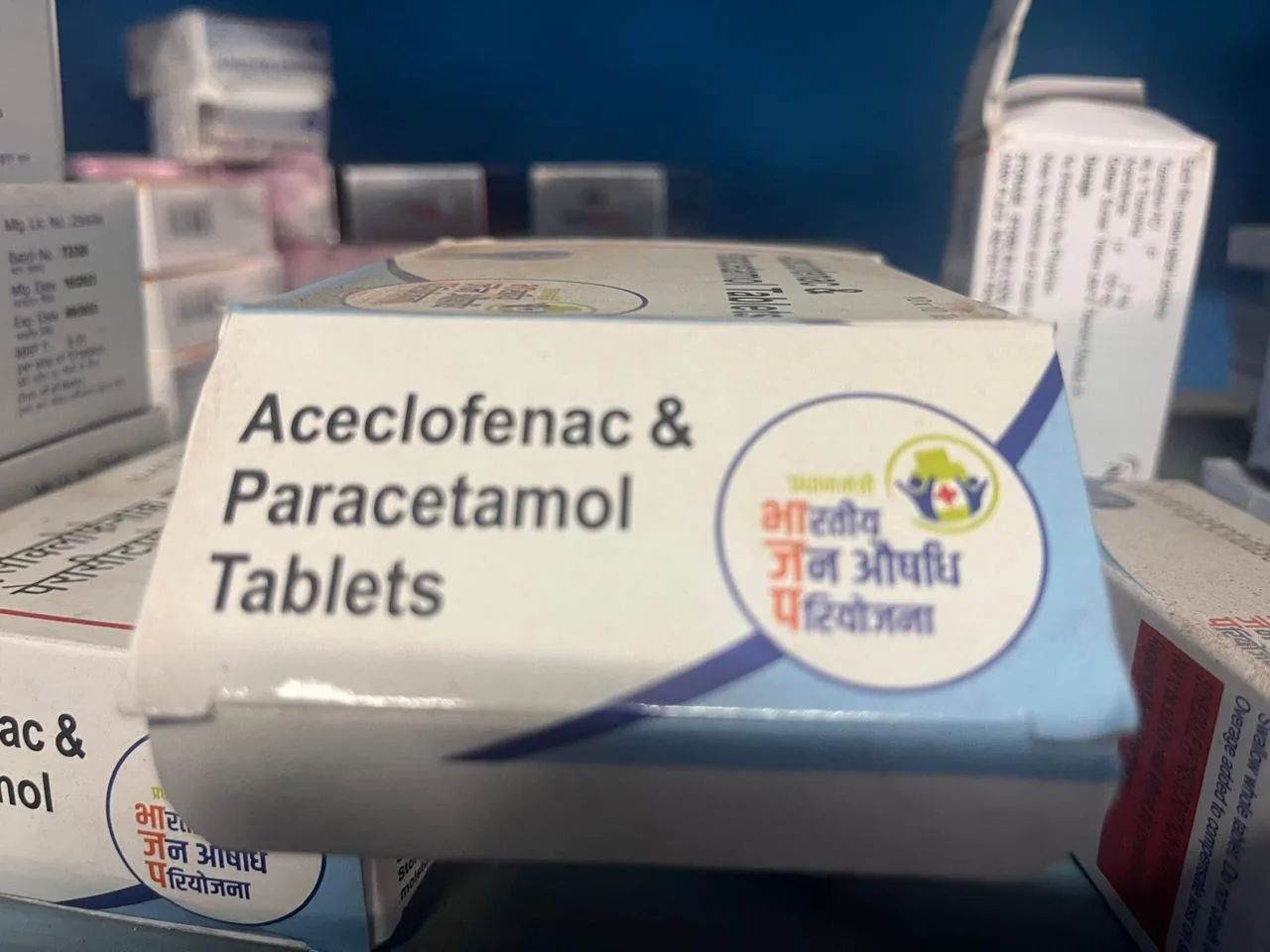
But the larger question is, whether beyond the political narrative, there has been enough attention in design and implementation. How effective is this approach?
SG: I am not fully updated on recent developments. I will focus on a number of concerns that were expressed a few years back about this scheme. Firstly, we need Jan Aushadhi Kendras. No doubt about it. JAKs are essentially retail pharmacy shops that sell generics. The prices of generics could be one-hundredth the price of branded generics- and there could be a huge reduction in OOPE.
About 5 years ago there was about 300 of these. Now there are stated to be over 17,000. However, there are a lot of problems with the way these centres play out in practice. One problem is establishing them in district hospitals or other public hospitals so that these medicines are sold to patients seeking care from public providers. This undermines the understanding that government hospitals, and public facilities are supposed to provide medicines free of cost. And legitimises prescriptions for purchase in the open market- as for other reasons only a small part of the required medicines is available in these centres.
When it comes to private providers, few can be persuaded to prescribe generics because of the push from pharmaceutical marketing companies. They don’t believe in, or encourage it- and only branded generics are promoted. It makes it difficult for a JAK to be viable based on prescriptions from private providers.
Then there was the stipulation that the JAKs source their medicines only from public pharmaceuticals. But public pharmaceutical manufacturing firms produce very few of these medicines. Where the agents of public pharmaceuticals act as intermediaries for private manufacture, that defeats the purpose, and is dangerous, becoming a route for many non-ethical practices. But I guess that criteria is now relaxed wherein procurement can occur from private manufacturers/wholesalers.
Then there is the questions about JAKs own systems of procurement linked to quality assurance. Is it as robust as the TNMSC model. I do not know. Perhaps it is. I need to check the recent publications on this.
TS: I visited some JAKs recently. As you say they are located in public hospitals and cater mainly to public providers prescriptions. I found the effort to inform and persuade private providers of the district to prescribe generics or even inform the providers of the functioning of this generic pharmacy as almost non-existent. The pharmacists at the store and the officials in the district themselves have no confidence that generic medicines that are one-tenth the cost of branded generics have equal quality. It goes against their ‘common-sense’ so to speak. There is no information available on quality assurance mechanisms being followed. And most important there are considerable delays and interruptions in supply. Procurement and supply are centralised and it is unlikely that a TNMSC equivalent logistics system is in place. Local JAK pharmacists are often stocking and selling branded popular fast moving, costly medicines with larger retail margins, to make some income on the side. Potentially these problems can be addressed- but as of now, there is little recognition of these issues.
From what you are suggesting, I understand that as of now the most affordable way for access to medicines, both from the viewpoint of patients and from a societal viewpoint is. if medicines are procured and dispensed free of costs as a part of public service delivery. You have already mentioned that the Tamil Nadu Medical Services Corporation is the pioneer and model in this, and since then Rajasthan and Kerala too has established such a system. However, I note that many other states have also established an autonomous para-statal on the lines of TNMSC, but their results in terms of providing free medicines without patients incurring OOPE and ensuring uninterrupted supply of quality medicines is far below par. Now why is this? Could we have not got at least this part right?
SG: I think there are vested interests at work that come in the way of such transparent, quality assured procurement and distribution systems. Drug and medical device procurement and supply chain management is arguably the most important source of what is called fiduciary risk- or in plan language corruption. We know, from TNMSC, how to fix it, but we do not. Even Central Govt. procurement does not follow the robust procedures that TNMSC has laid down, or there are exemptions given to the purchase of many items, allowing these to be bought outside the TNMSC like protocols. Even CGHS (Central Government Health Scheme) doesn’t strictly follow generic prescriptions.
TS: What about manufacturing costs or pharmaceuticals and import costs? Are these going up too?
SG: One reason for increasing costs is the increasing dependence of Indian pharmaceuticals on imported APIs-or Active Pharmaceutical Ingredients- otherwise known as bulk drugs. A formulation is the chemical form in which the medicine is ready to use, the form in which we buy medicines. API is the raw material. So, until the 90s, both in API as well as in formulations, India was strong, domestically manufacturing 90% of our own formulations and about 80% of the API. But as of today, over 85 % of API are not produced domestically anymore, they are imported, and over 90 percent of the imports are from China. China has a big sway over API production. Therefore, when we talk about price rise of medicines, actually we must link it to the rising costs of imported APIs, and the changes in dollar or yuan-to-rupee exchange rates too. Last year, we experienced a sharp decline of the rupee in exchange rates. This too is a major factor for increase in prices.
TS: What about patented medicines? Why has India not brought these under price control. To me, that is surprising, because you are pointing out that globally it is patented medicines that attract price control.
SG: Well they are not. The companies do not want it. There are even two or three papers brought out by the, Department of Pharmaceuticals calling for this, but the influence of the companies on government policies prevails.
TS: Could I ask you about biologics. This is a rapidly growing area of medicines, and biologics are hugely costly. Where are we will price control.
SG: Biologics are a different category. The three segments that I talked about relate to chemical entities. They are not biologicals. So, what is a biological? These are complex organic molecules. Vaccines are biologicals, insulin is a biological, anti-venoms are biologics, and so are immunoglobins and medicines derived from them. Most of them are patented, very few are off-patent. We don’t call the off-patent biologics manufactured by non-patent holding firms as generics. These are called biosimilars. Among the developing countries only 4 or 5 countries have mastered the act of manufacturing bio-similars. China and India are one of the best. Along with that Brazil, Mexico, Bangladesh and Cuba.
These countries started their manufacturing base in the 60s and 70s, and all of these had also robust public pharmaceutical sector. This led to robust chemical laboratories and the skilled manpower to produce it. But in biologics we did not have that sort of self-sufficiency. However we are getting there, but I don’t know how long it will take. A few companies are investing in the R&D required for biosimilars. We however are not really in the contest for patented biologicals. Both in terms of developing the scientific capacity, the innovation regimes and the investment, we have a long way to go. But biologics and biosimilars are a very important area. As with the example of insulin, the use and requirements affordable biologics is going to expand exponentially. But as I pointed out with API, with the weakening of public pharma, we are even losing capacities we already possessed. A number of leading Indian big pharmaceutical firms are also getting acquired by global finance capital and corporations. So the motivation for self-sufficiency is also under threat.
TS: A closing question. What about production in public pharmaceutical companies? Could we get back to that on scale? Would that make a difference in ensuring affordability of medicines?
SG: Yeah, I think we need to have another conversation on this. The policy environment required for strengthening PSUs does not exist. We only have two or three major public sector companies left, and even they produce minimal quantities. So, they’ve lost out to private manufacturers and the policy space doesn’t exist. Can it be recovered, and if so how- and why- that is another conversation.
Acknowledgements: Many thanks to Ms Roubitha David, for her assistance in recording and transcription of this conversation.
This conversation is the 30th of our series, all of which is published in the Right to Health (RTH) Resource Collective’s Website. The earlier published conversations can also be accessed here.
Please post your feedback or queries in any of the social media channels or at the space given at the end of this conversation and we our guest for this conversation will be happy to respond to the same.
