

Lessons from Tamil Nadu’s Palli Kalvi Padukappu Iyakkam (PKPI) (Save School Education Movement)
This is a conversation with Mr J. Krishnamurthy, one of the iconic leaders of the total literacy campaign, first in Puducherry and then in Tamil Nadu from 1989 to the late nineties. In the last 10 years, he along with another equally famous TLC leader, Prof. S. Madasamy has been leading a movement for saving public school. In Tamil this is called the Palli Kalvi Padukappu Iyakkam (PKPI) which loosely translates into Save School Education movement. This is about saving public schools. We undertake this conversation because we feel that what the PKPI has done has great relevance to civil society action to save public health care and for the right to health. It also has many basic lessons for why rights legislation succeeds only to the extent that there is community mobilization and decentralized participatory governance.
TS: Could you start by telling us the origins of the PKPI (Save school education movement).
JK: The movement was established in 2017. But let me start earlier. In June 2013, at the verge of my retirement when after three decades of services as a school teacher and then headmaster in government schools in Puducherry, we started a movement called Puducherry Kalvi Padukappu Iyakkan. Along with some of the teachers, students and some education volunteers a group of us travelled to around 100 government schools in Puducherry, to increase enrollment and secure volunteer support. At that time, we did not have a clear strategy.
The emergence of the PKPI: After 4 years, our work was noticed by Dr. Vasanthi Devi, retired Vice Chancellor of Manonmani Sundaranar University, Tirunelveli, largely from our Facebook posts. She passed away recently in August 2025. She suggested that we invite a number of organizations which work on education, who were interested in saving government schools for a meeting. This meeting took place and on November, 18th 2017, the PKPI was officially launched. Many organisations including Tamil Nadu Science Forum, students and teachers’ movements attended that meeting. Dr Vasanthi Devi’s leadership emphasized that the main tool of the movement would be the School Management Committees(SMCs), which are mandated as part of the Right to Education Act. These were meant to invite parents/people to own the schools as their own. The guidelines were that at least 15 of the 20 School Management Committee(SMC) members were to be parents of the school children, and there should be representation from weaker sections and for the differently abled. The idea was to make these committees meet regularly. Also, for volunteers from PKPI to attend Gram Sabha meetings to place school education on their agenda. All of this was not very successful as we were very few, and till 2020 we had limited impact. SMC meetings either happened only on paper, or in a very limited way. We did however identify 10 headmasters who had re-vitalised SMCs leading to major significant positive difference, and we called them the PKPI ambassadors.
The ITK phase: Then the pandemic happened. This was an unprecedented crisis in the schooling system and it hit the government schools the worst. In private schools some level of online education was initiated, but most students of government schools and their families were not ready for this. Most did not even have smart phones. The social isolation was also a mental crisis for children. At Prof. Madasamy’s suggestion we decided to start volunteer teams who will meet the children for a few hours in the streets of their residential areas for some very basic classes, plus singing songs, playing games and bringing back some collective interaction and joy. We started such Veedhi Vaghuparais (street classes) in two places but the Veedhi Vaghuparais rapidly expanded to about 150 villages across 25 districts. A drop in the ocean, but still a start. And then it got noticed in social media. One day the PA to the minister called us up and suggested a meeting. In the meeting held on September 3rd, 2020, attended by senior IAS officers of the department, he requested our support to expand this programme to all government schools. Thus, was born the Illam Thedia Kalvi (ITK) Programmes, which loosely translates into Home-education programme. We were not the only organisations invited. It included TNSF, Aid-India and others. I am only sharing our PKPI experience and we also think that the idea was largely born from our street schools.
This ITK programme took off very well, partly due to an excellent and hard-working IAS officer at the helm. Around one lakh villages were covered. About 2 lakh volunteers were recruited, almost entire young women, and they were paid an honorarium of Rs 1000 per month. They were trained online and we could contribute to this. It was a good programme during difficult days and won much appreciation.
The immediate post-pandemic SMC phase: By 2022, the pandemic had passed and this phase of the ITK came to an end. The enthusiasms and public involvement secured continued to manifest, with some schools showing much higher public involvement, patents doing voluntary services, making donations and so on. This was without any guidelines or instructions from above. But we saw in this a great opportunity to strengthen the SMCs, our original objective. One officer in the department too observed this and set up a meeting on this. In this meeting with us and other organisations it was decided to make a campaign to strengthen the SMCs. Largely implemented through the school education department officials, the PKPI and other organisations were given adequate space. The plan consisted of asking all school headmasters to invite parents of all the school children on a given day. Then on another synchronized day, the school management committees were to be elected- this was called the SMC re-constitution day. State and district resource person teams were also formed. After the reconstitution day, in the last Friday of every month, from 3 to 4.30 pam the meeting of the SMC was to be conducted and its decisions communicated.
Given the structuring of these activities as a campaign all this happened. However, there was no follow up action on SMC decision. To change this a digital dashboard was created and all SMC resolutions were to be uploaded on this with district collector and other assigned officers to follow up on gaps, grievances and requests. Closure of the gaps required action from over 16 government departments and therefore the gaps reported were categorised and sent to each department. At the state level, the chief secretary took interest and he followed up with district collectors. For a time the SMCs, as envisaged under the Right to Education Act were in place.
The big set-back: But this was not to last. In one school in Chennai, one guest speaker invited by the school, gave a speech that was derogatory to those with disabilities and weaker sections. The speech got circulated on social media and the department over-reacted, closing down all SMCs meetings till further notice. Seemed to have happened on the advice of legal department which was completely disconnected from what was happening. A few positive headmasters and SMCs persisted, but unfortunately most came to a halt.
And a slow recovery: Slowly this revived, first school managements meetings were allowed for specific purposes and then with monthly regularity. Now the strictures against SMCs are no longer present, and they do meet, though not so proactively as before. This is the current phase. In this revival, once again PKPI had a role.
TS: I think you have now brought us to the current phase. But how did PKPI help overcome the set-back and what role does it play now:
JK: I think our learning from the set-back was we need that while as tactics we continue to work with and within government where-ever possible, as strategy we keep an independent line of action outside of government that proceeds despite the back and forth of collaborative spaces. When government was driving the SMCs, our role was in encouraging parents to attend and to give voice the immediate needs of infrastructure, teachers, amenities. After this set-back we decided to create one voluntary PKPI coordinator per school, (oru nabar, oru palli) who is resident in the village and who make it their responsibility for revival and improvement of the public school. His/Her first task would be to create a Oor Kalvi Kuzhu (OKK) or Habitation School Committee. They have to somehow develop a very good relation with the headmaster, the teachers, because without having a good relation with the headmaster and the teachers, it’s slightly impossible to develop this. We also formed a state and a district coordination committee, but of these the local committee was the most difficult- since there is so much of politics in the village. The committee is made up of parents and the school’s alumni and the present school management committee members. Before or when government announces a date for SMC meeting, committee will gather and discuss about the school problem and then raise these issues in the school management committee meeting conducted by the government. We also have a rule that even in the state and district coordination committee members must be the local coordinator for at least one government school near where they reside.
Today we have functional OKKs in about 560 villages. Not a big amount if we consider that there are close to 38,700 government schools in Tamil Nadu. But this grounded approach means that we can observe and intervene in what changes are taking place and highlight this directly with district and state authorities too whenever there is a receptive officer on the government side- which is not always. Of the 38 districts, I would say that we have effective functional programmes in 14 districts, a partial success in about 11 districts and only a token presence in the remaining 13 districts.
Our work also gets highlighted and gains increasing support from our over 8000 Facebook followers and the 2000 activists or friends who are in one of our district PKPI WhatsApp groups.
TS: Can you give me an idea of what are the activities that now take place in a village with a PKPI led save the school committee?
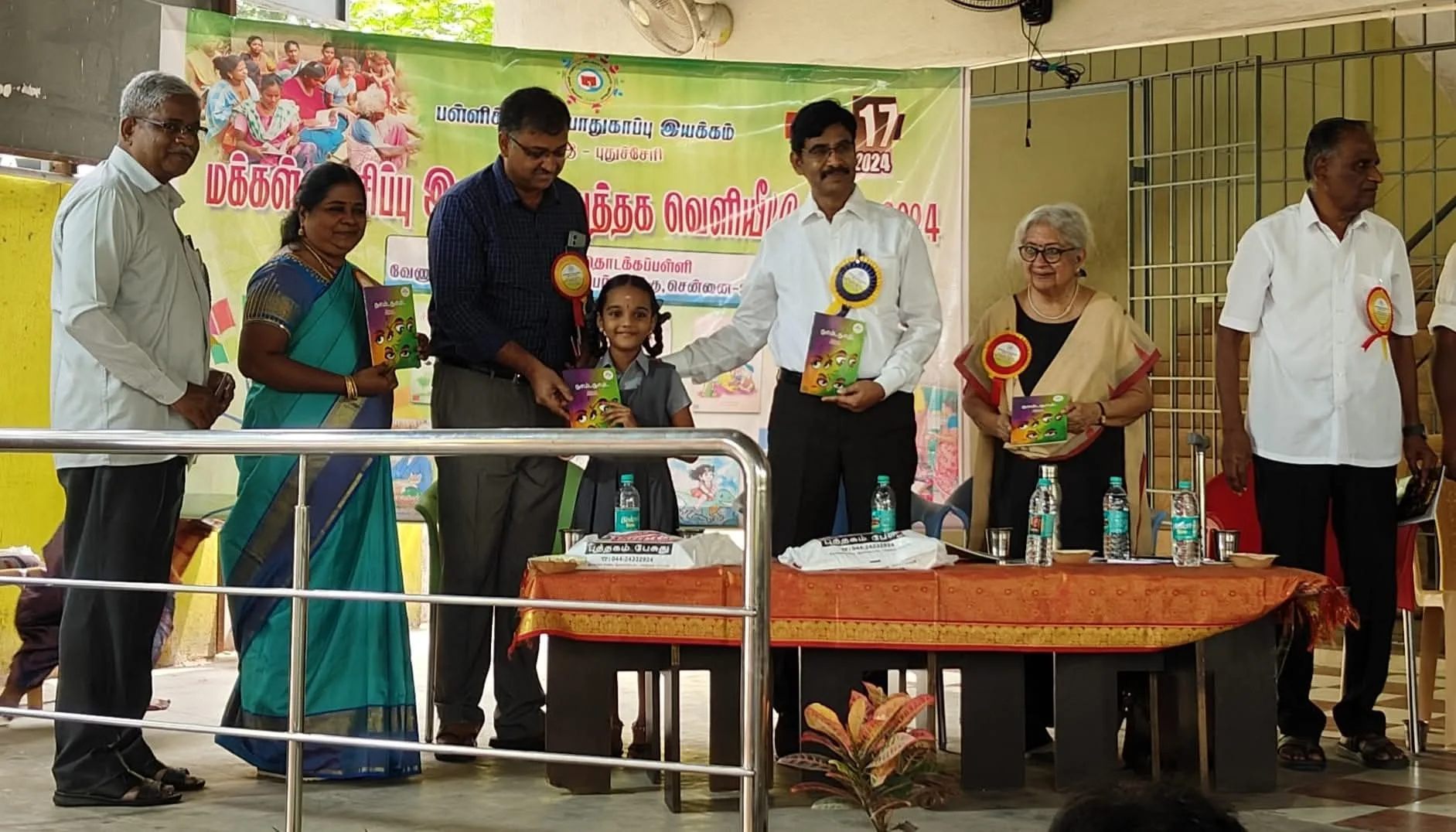
JK: One activity, which is a obligatory is to convene the OKK committee and discuss issues that need to be addressed in school functioning and raise it in the school. But another major activity is to stimulate dialogue and a thirst for education in the committee members themselves and in the public. And confidence too in being able to read. To achieve this, we have a Vasippu Iyakkam ( peoples reading campaign). For this purpose, we introduce very simple books. In each meeting of the OKK, one or two books are read aloud before other business is transacted. There are some principles on which the book is designed. It has a maximum of 16 pages, which is 20 including the cover pages. There are four competency levels- Nuzhai, Nada, Odu, Para (Enter, Walk, Run and Fly). The entry level has large pictures on each page, and only a phrase or sentence of text. Then as the competency level increases the text increases and picture size decreases- but we keep to a total of 20 pages.
These books were also part of the government SMC strategy. The government agreed to print 250 titles, so as to provide one copy of each title to each section of each class to encourage reading it aloud. So, for each title about 2 lakh copies would be printed. As of now 205 titles have been published and the rest are on their way. None of these are available for sale or with PKPI. These were developed workshop organised by the department with support of PKPI. These books are meant to be read out in government schools by the teachers. But to make this happen, the programme also selected a volunteer, usually an ITK resource person, would visit the school and read these books out. Each ITK volunteer would be responsible for reading these out in 10 schools and each school gets visited once every week. They were paid Rs 8,000 per month. This was extensively organised in 11 districts. It was a fantastic experience. When these ITK volunteers go there, the children would rush to the volunteer. This phase lasted for all of one year- from July 2023 to June 2024. Unfortunately, when the state officer who had initiated this scaling up of SMCs changed this got dropped. The next officer, on grounds of saving the expenditure, thought it was enough to designate a period in the week to reading out the books.
But to keep out strategic independence also going, the PKPI is also publishing its own collection of a 23 book set which we sell for Rs 460 or about Rs 20 per set. This is published in coordination with Bharati Puthakalayam, a 1000 copies of each title. Seven more books are on the way- and so it will be a set of 30 books soon. And the reading loud is planned in all our active villages. PKPI declared November 8th, (Dr Vasanthi Devi’s birthday) as Vasanthi Devi Reading day. On this day the reading aloud sessions happened in about 200 villages.
TS: To summarize: PKPI is directly active at the level of village or urban ward in over 560 sites across 25 districts and indirectly, by a pressure to keep the SMCs active it goes to all schools. In an active site there is a coordinator, a coordinating committee, a reading campaign, monthly meetings that address issues related to the school, and collective interventions for school improvement. Could you elaborate on the last of these – collective interventions for school improvement. Could you elaborate on the last of these, especially in the context of so many schools being shut.
JK: Closure of schools is a big issue. Over 208 schools closed- and the reasons given are a lack of children due to the demographic transition and a choice made for private schooling. However, where-ever we are able to intervene, we find a different situation. Let me give you a few examples. In village Vilankulam, near Pattukottai town, the school was closing because there were only two students. The local organiser, Mr Veeraiyan, gave a letter to the management, offering to ensure that children attended. They went house to house and identified children not in school or not able to afford private school. Attendance increased to 23 children.
Another example: In a village called Nadupalayam in Erode district, the school was left with only two children. Mr Nadaraj, the PKPI convenor, organised meetings of the Oor Kalvi Kuzhu (OKK) which in turn activated the School management committee. Then Nadaraj arranged for two volunteers to start teaching and they did so without pay for 3 months. One of them was his wife. With confidence restored that the school will function, the children came back. Now there are over 100 children in this school.
Yet another example: This is from Senkottai in 2019 and the school rescue was led by a teacher-activist- David. Faced with the problem of very few students, the first response was to go meet parents and persuade them to enroll. But then the committee decided that before we do that, let us improve the school and work hard to improve the quality of education. They undertook to paint the walls, cleaned and renovated the toilets, provided safe drinking water, created a small garden, and improved the content of the class room transaction. After a year of this they said- yes, now let us go and meet the parents. Hearing of this, the students in the school said, we will come along also. The students accompanied with activists, and would open the book and demonstrate that they could read and explain the content of any page that was selected for them. It was clear to the parents that this was more then what their children in the private schools were doing. But they had paid the annual school fees. In some cases. the activist offered to reimburse in part the money they had paid, but in most cases even without this, the parents brought back the children to the government school. Now it has over 200 children in the different classes.
TS: What you are indicating in all these examples is also that there are a number of children who are out of school because the government school is non-functional and the private school is unaffordable. So when the public school becomes functional the enrolment comes back!! Is this so?
JK: Yes- this is indeed the situation. We have no data, but our entire field experience points to increasing out of school children. So, there is a real danger that the universal enrolment that we achieved after decades of struggle is in danger of being reversed. It is this fear that drives us. Along with this is the new problem of increasing household expenditure on private schooling, much of which is of very poor quality.
TS: And what is the relative quality of schooling across public and private schools?
JK: There is little difference. More often the government schools have the better qualified teachers and better books and curriculum. However, government schools can be more dysfunctional due to poor infrastructure management and teacher post vacancies. However, a significant part of the poor functioning of the school rests on the very poor work-culture. Given the fact, that the number of children in public schools is low- and over a 1000 government schools are in single digit numbers, the teachers should have been able to give better outputs. But many children still cannot read Tamil or English or do simple mathematics. Our PKPI experience is that about 50 percent of teachers are working well below their potential. One reason for this is very poor monitoring and supervision. The inclusion of a large number of apps is no substitute for school visits and interactions with school teachers. Hopefully with school management committees revived, they should do better.
There are a number of examples that illustrate how the shift to private schools happens and why and how we can reverse it.
One early example we cite is from Munneerpalam village in Palayamkottai and the lead activist, I think was named Gandhiraja. In that area the children had shifted to private schools, including some of repute, calling themselves international schools. Motivated by the committee, the teachers discussed what could be done. One of the major barriers was the shabby appearance of the school. The school headmaster was too timid to go to the authorities for more funds. So they decided to put up some money and over the evenings paint art work on the walls and improve the school appearance themselves. As they were doing it, a passing individual became curious, stopped and asked why they were working late evening on such a task. It turned out that he was an alumnus of that school now working as a faculty in an IT firm of a nearby town. He met the HM next day and offered to help. Presented with a budget of Rs 3 lakhs he readily offered to raise that sum for the school, so that the teachers could focus on the teaching. Its three years since. The school is much improved and functioning at full capacity with over 205 students, despite many private schools in that area.
Another example that has a lesson is from Narikattiyur village in Karur District. Here the headmaster Vijayalalitha was herself the activist. When she joined the school had only 5 students. She decided to focus her first year on brightening the school appearance, and improve learning outcomes before appealing for more enrolment. Once again this worked and this school now has over 400 enrolled children.
Learning from all these examples, I would say that there are two important elements of retaining students in government schools. One is an assurance in the quality of education, and the other is also a good infrastructure that helps parents to take pride in the school where they are sending their children to learn. This feeling of pride in the school is very important.
TS: I think you could go on with many more examples if I let you. Please try and record these testimonies with photographs and we will make web-space available to document this. But I have a larger question. Is not maintaining the infrastructure and monitoring the quality of school education, the government’s job. Should we encourage voluntary organisations to take this up? Are we not better off demanding that government stick to its obligations.
JK: Of course. It is the governments obligation and we support all movements that demand education for all as a right. But even to sustain such a strategy, we need insights from what is happening within, and ways to create positive changes that reinforce public pressure and build a favorable public opinion. Working within schools and with school management committees is the ideal tactics we bring to bear. The school management committee approaching the higher authorities for funds for the school has more impact than if the headmaster does so. And if the authority does not give a time commitment, and undertake the task within that period, the activist can escalate the request to the elected authorities or the media.
TS: A word about PKPI itself. Could you elaborate on its organizational structure and principles.
JK: We don’t have any membership. We don’t have any paid membership. We say that we are all activists. If anyone wants to be part of PKPI we welcome them and say: “please adopt one particular school and relate to its development. We will guide you. We will come with you and help you.’ So that is the requirement- that the member should engage in the improvement of one government school, and work for the development of that school for the next two to three years. Even the knowledge that they can and will do so helps build the pressure. We have brought out two booklets called “Where is Education for All” and the other is “Save Education, Save the Nation” and about 10 one-page pamphlets. These explain our movement. Over 10,000 copies of each have been printed and disseminated.
At the state level, earlier Dr Vasanthi Devi was our president. We do not have that post anymore. Now Madasamy and myself are the main coordinators and we act through a 20-member state coordination committee. Including the two of us it is 22 persons. Of these five are joint coordinators and 5 are assistant coordinators, and they represent the five zones. These 11 office bearers undertake most of the planning and implementation. Every one of them is voluntary, and doing this work in addition to their respective jobs. No one is paid. The organisation is not registered. There are no bank account of funds and we raise donations or sponsors for each event. There is also an advisory committee. There are similar district coordination committees in all districts. In a few districts we have established block coordination committees as well.
TS: I assume that most of those in the district and below will be school teachers. Do they not come into conflict with the school administration when they bring pressure from the outside- the strategic engagement.
JK: About half the district coordinators are school teachers. We have two district coordinators, one a man and one woman The woman coordinator is invariably an ITK activist and the man a parent or teacher activist. There is little chance of conflict with government- since we do not criticize government from this platform. We are working to improve school enrollment and amenities through the school management committee and that is the same as official policy. On the other hand, there are often conflicts between the head of SMC and the headmaster, especially if the latter is resentful of the SMC’s interference and the SMC is not tactful in engaging with the headmaster and teachers. When government support is proactive it is easy to overcome these gaps. But where government is in retreat, it takes more tact from civil society to maintain the engagement.
TS: Thank You JK. As I know it, the problem of neglect and closure of government schools is much worse in many of the states in northern and central India, and I hope that this experience inspires similar interventions in these states also. One general learning from this conversation is the way we need to combine working from within public institutions when the situation allows, with working from outside at both local levels and in the policy space. I liked the quote you mentioned that “when working with governments one needs to work tactically from within and strategically from outside.”
A similar form of engagement may have relevance for primary health care also. Policy makers have to recognize that realisation of right to health, like the right to education, requires different forms of community engagement both from within and from outside. And peoples movements and civil society organisations also search for innovative ways to support successful delivery of public primary health care services at the local level, even as they retain an independent strategy from outside to ensure that health and education are seen as public goods.
Editorial Note: This is the 28th conversation in this series. It is the only one so far on school education. The rest are on public health and health rights. These conversations can be accessed at https://rthresources.in/
About the Participant:
Mr. J. Krishnamoorthy is a well known public intellectual in Puducherry and Tamil Nadu with more than 36 years of experience in school education. He started his career in 1976 in Puducherry as a middle school teacher. JK as he is fondly called is a founding member and organiser of Puducherry Science Forum (est. 1985) and the Tamil Nadu Science Forum. He has served as State General Secretary of the Tamil Nadu Science Forum (1994 – 96). As the manager of the South Zones, Bharat Jan Vigyan Jatha in 1987, he is also one of those who helped establish the All India Peoples Science Network. He is however best known for his leadership in Puducherry Arivoli Iyyakkam, the Total Literacy Campaigns, which won the King Sejong International Literacy Award in 1992 and triggered of the nation-wide total literacy campaigns. Between 1992 – 96 he also served as one of the 35 national consultants for the Bharat Gyan Vigyan Samithi, to implement total literacy programs across the country. Mr. Krishnamoorthy moved back to Puducherry in 1996, and from then to his retirement in 2013, he solely focused on children’s education as a teacher, and middle and higher secondary Govt. school headmaster. Mr. J. Krishnamoorthy is the founding member and secretary of PKPI.
He can be contacted on email : jkpondy1@gmail.com
